Small Apartment Bathroom Decor Ideas for Renters (No Renovation)
This post may contain affiliate links. As an Amazon Associate we earn from qualifying purchases. See our affiliate disclosure.
Most small apartment bathrooms look the same: beige tile, a builder-grade mirror, a vanity with no counter space, and a landlord who will not let you change any of it. You do not need a renovation to fix that. With the right shower curtain, freestanding storage, and matching accessories, a 30 to 50 square foot rental bathroom can look intentional instead of accidental — for under $100. Everything here is deposit-safe: no drilling, no painting, no permanent changes, and it can all move with you to your next apartment. Prices in this guide are ranges based on typical Amazon and big-box store prices, checked November 2026.
TL;DR — The Quick Answer
Start with a light-colored shower curtain hung high, add a freestanding over-toilet shelf for storage, and corral the vanity with a tray and matching pump bottles. Those three moves cost roughly $45–$85, take under an hour, and change the look of the room more than anything else. Add matching towels, a washable bath mat, and battery LED lighting, and the bathroom reads as finished rather than temporary.
At a Glance: Small Bathroom Decor Ideas for Renters
| Idea | Cost | Time | Renter-safe? | Where to buy |
|---|---|---|---|---|
| Light shower curtain, hung high | $12–$30 | 15 min | Yes | Amazon, Target, IKEA |
| Over-toilet shelving unit | $25–$60 | 20–30 min | Yes | Amazon, Walmart |
| Vanity tray + matching dispensers | $15–$35 | 5 min | Yes | Amazon, TJ Maxx, Target |
| Peel-and-stick tile or wallpaper | $15–$45 | 1–2 hrs | Yes, if removable | Amazon, home stores |
| Battery LED mirror light | $10–$25 | 10 min | Yes | Amazon |
| Matching towels + washable bath mat | $20–$45 | 5 min | Yes | Amazon, Target, IKEA |
| Under-sink organizer | $12–$30 | 15 min | Yes | Amazon, Dollar Tree |
| Over-door hooks and organizer | $8–$20 | 5 min | Yes | Amazon, Target |
A full refresh runs $75–$150, depending on what you already own. If your budget is tighter, the $50 plan near the end covers the three highest-impact changes and nothing else.
1. Hang a Light Shower Curtain High and Wide
The shower curtain is the largest single surface in most small bathrooms, so it sets the tone for the whole room more than any other item. In a typical rental bathroom, the tub or shower takes up roughly a third of the floor space, and the curtain covering it is often the first thing you see when you walk in. That makes it the cheapest way to change the room.
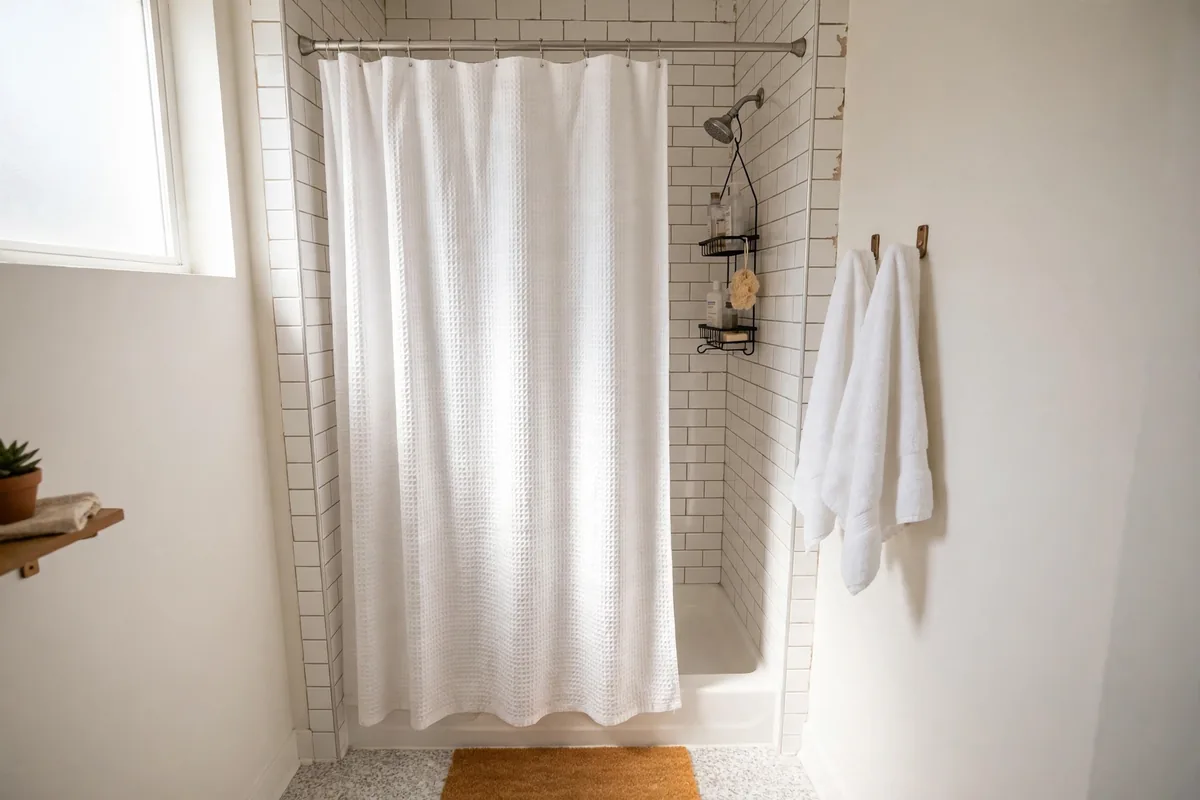
Choose a light color — white, cream, pale sage, or a soft stripe — in a waffle weave or linen-look fabric. Dark curtains shrink a small room, while light ones bounce light around and make it feel taller. A standard curtain measures 72 by 72 inches, which fits most rental tubs; a 70-inch length avoids pooling if your ceiling is low.
Hang the curtain rod as high as you can, ideally 75 to 78 inches from the floor, and extend a tension rod a few inches wider than the tub on each side. Raising the rod makes the ceiling look higher — the same trick designers use with window curtains. A tension rod costs $8–$15, needs no drilling, and holds a fabric curtain easily. Pair the outer curtain with a clear or white liner ($5–$10) so water stays in the tub and the outer curtain stays dry.
What to avoid: plastic curtains with printed scenery or heavy patterns, which read as cheap and date the room fast. Avoid a curtain that is too short — a gap at the bottom looks unfinished and lets water splash out. And do not use a spring rod that is too weak for a heavy fabric curtain; check the weight rating before you buy.
Shop: waffle shower curtain ($12–$25), tension shower curtain rod ($8–$15).
2. Add Freestanding Over-Toilet Storage
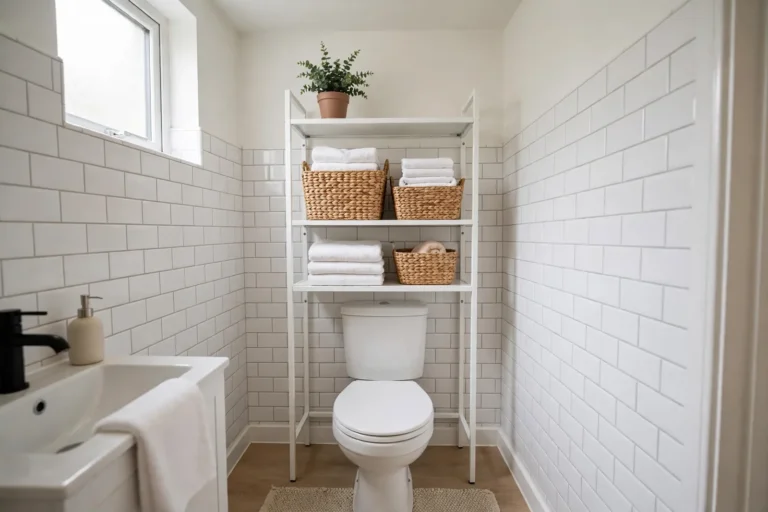
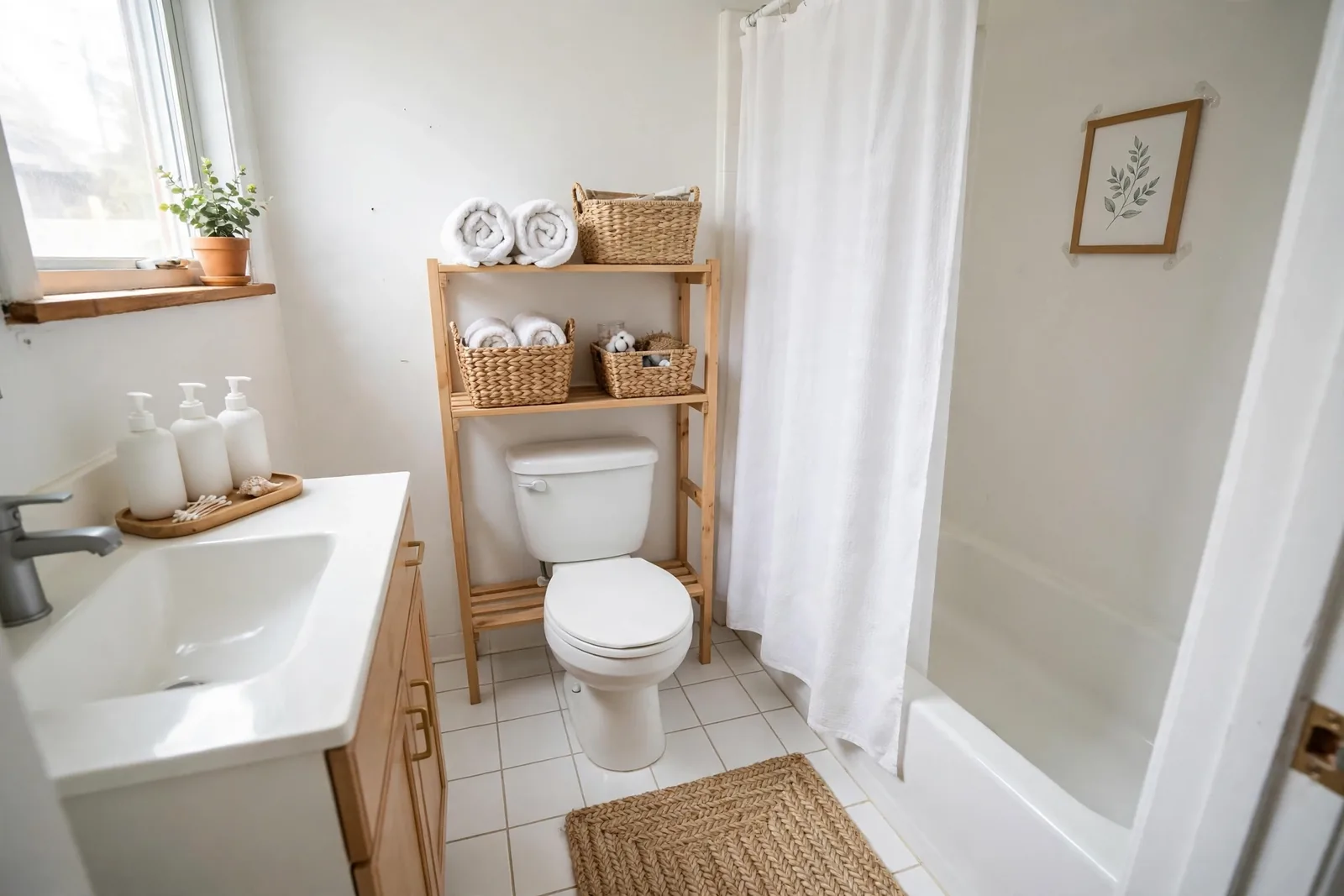
The wall above the toilet is the most wasted space in a small bathroom. It is roughly 24 inches wide and 30 inches tall of empty wall that most renters never use — and it is exactly where storage belongs, because nothing else can go there. A freestanding over-toilet shelf unit stands on the floor and straddles the tank, so it needs no screws, no adhesive, and no permission from your landlord.
Before you buy, measure. The gap between the toilet tank and the wall is usually 2 to 4 inches, and the unit’s legs must fit on either side of the tank. Most units are 23 to 25 inches wide and 62 to 68 inches tall, with two or three shelves. The bottom shelf should sit at least 2 inches above the tank lid so you can lift it off, and a depth of 9 to 10 inches will not crowd a narrow room.
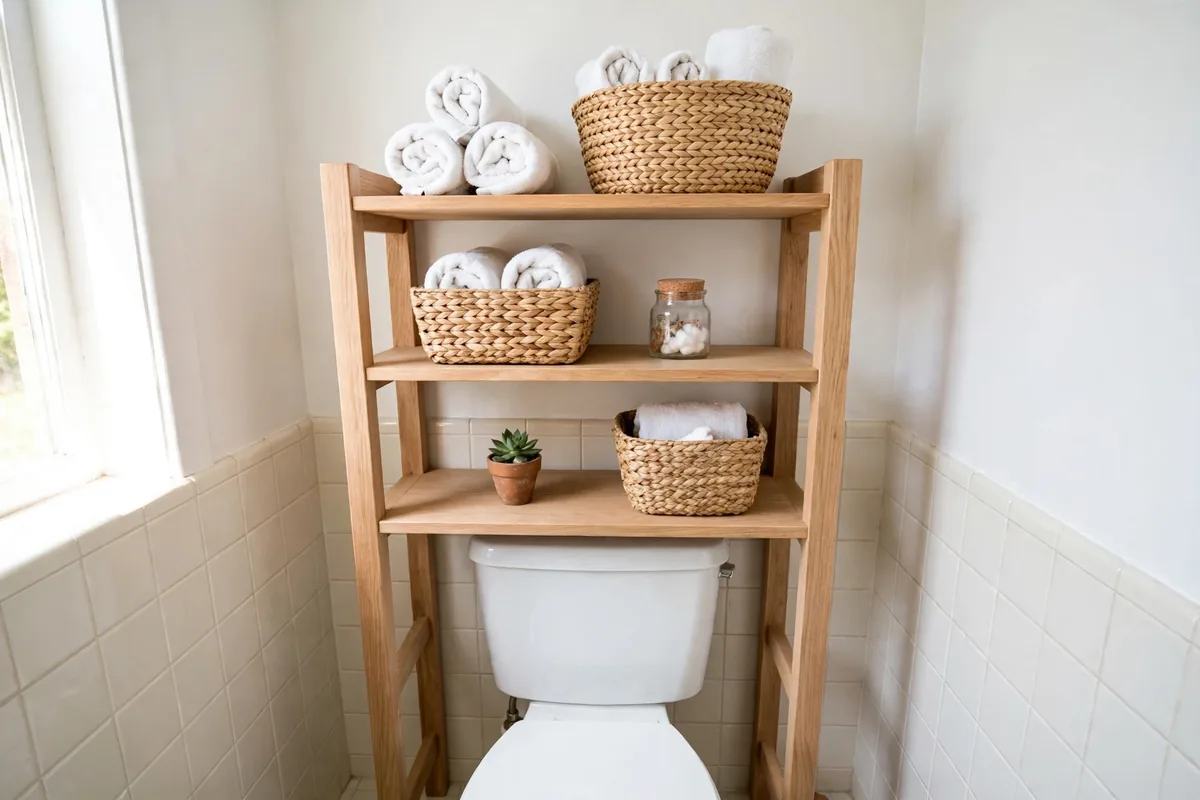
Style the shelves like a store display, not a medicine cabinet. Rolled white towels on the bottom shelf, two matching woven baskets in the middle for toilet paper and toiletries, and one small plant or jar on top. Keep it to five or six items; an overstuffed shelf looks cluttered and defeats the purpose. Woven baskets cost $6–$15 each and hide the messy reality of extra rolls and cleaning supplies.
What to avoid: metal units with thin wire shelves, which sag under the weight of towels and look flimsy within months. Avoid placing anything breakable directly above the toilet tank, and never block access to the tank lid — you will need it if the toilet ever runs. For a full comparison of styles, sizes, and prices, see our guide to the best over-the-toilet storage for small bathrooms.
Shop: over-toilet storage shelf ($25–$60), woven seagrass baskets ($6–$15 each).
3. Corral the Vanity With a Tray and Matching Dispensers
Rental vanities are almost always too small. A typical apartment vanity is 24 inches wide, which leaves about 8 inches of usable counter on each side of the sink — and that space fills up fast with a toothbrush cup, a soap bottle, and whatever else migrates there. The fix is not more space. It is a boundary.
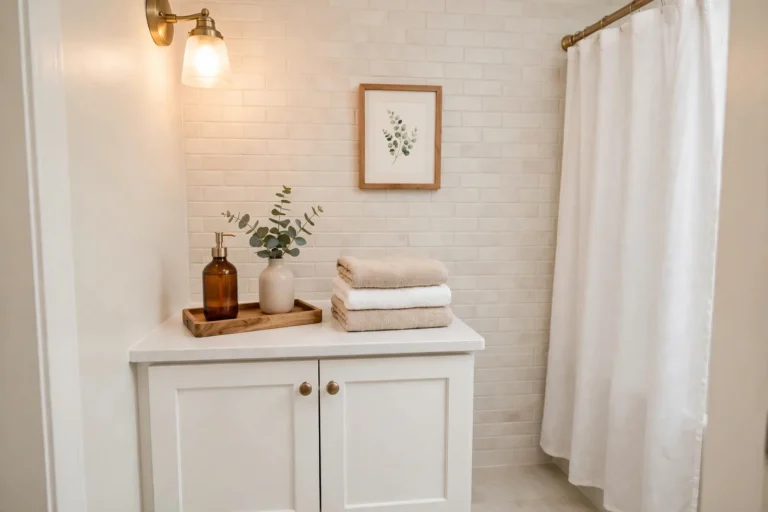
A vanity tray — wood, ceramic, or stone, roughly 10 by 14 inches — gives everything a home. Put matching pump bottles for hand soap and lotion on it, a small dish for rings or hair ties, and nothing else. When the tray is full, the rule is simple: something has to leave before anything new goes on. The matching bottles matter more than you would expect. Five mismatched plastic bottles look like clutter; two matching amber glass or ceramic dispensers look like a hotel.
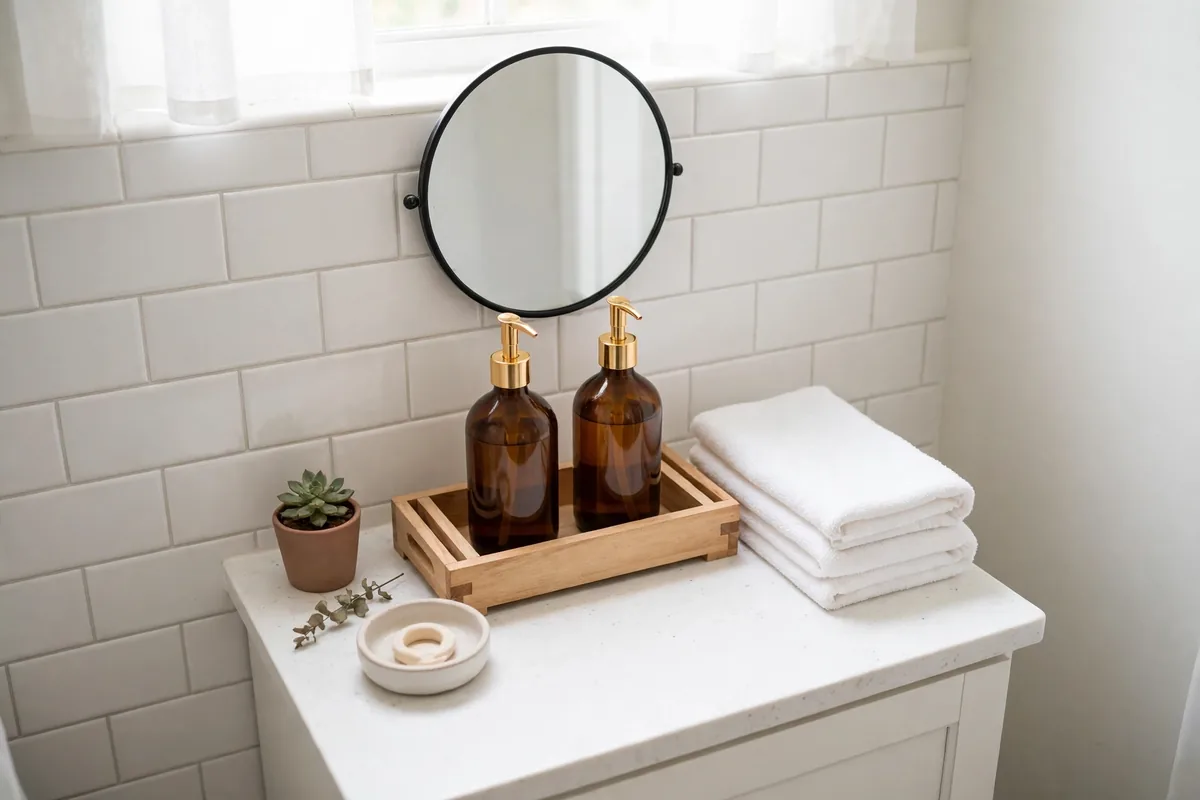
Refillable dispensers cost $10–$20 for a pair and pay for themselves quickly, since refill soap is cheaper per ounce than a new pump bottle every time. Choose bottles with a pump that handles thick lotion — cheap pumps clog. Keep a folded hand towel beside the tray, not on it, so the surface stays dry.
What to avoid: trays that are too big for the vanity — measure first, and leave at least 2 inches of clear counter on each side. Avoid glass trays on a pedestal sink, where there is no flat surface to hold them steady. And do not keep products you use once a month on the counter; they belong in a basket under the sink.
Shop: amber glass soap dispenser set ($10–$20), wooden vanity tray ($12–$25).
4. Cover Ugly Tile With Peel-and-Stick (the Right Way)
Ugly tile is the number-one complaint renters have about their bathrooms — pink 1970s tile, beige squares, or a floor that has seen better decades. Replacing tile is not an option in a rental, but covering it temporarily is. Peel-and-stick tile decals and removable wallpaper are made for exactly this problem, as long as you choose products rated for moisture and apply them correctly.
For walls, peel-and-stick subway tile sheets are the most forgiving option. They come in sheets of about 10 by 12 inches at $8–$15 per pack of ten, and one accent wall usually needs two to three packs ($15–$45 total). A typical accent wall is about 40 square feet and most packs cover 8 to 10, so buy one extra pack — running out mid-wall is the most common mistake.
For floors, peel-and-stick vinyl floor tiles are a bigger commitment and a bigger payoff. A small bathroom floor is usually 25 to 35 square feet, and tiles cost $1–$2 per square foot, so the whole floor runs $25–$70. Clean the floor thoroughly first — any dust or moisture underneath will lift the edges within weeks — and trim tiles around the toilet base with a utility knife.
What to avoid: applying peel-and-stick products to damp, dirty, or textured surfaces — they will peel within days. Do not use them inside the shower itself, where constant water exposure will destroy the adhesive. And read the removal instructions before you buy: genuine removable products come off cleanly with a hair dryer and patience, while cheap vinyl can pull paint off the wall. Always test one tile in a hidden spot for 48 hours before committing to a whole wall, and check your lease — some landlords specifically ban adhesive products, even removable ones.
Shop: peel-and-stick subway tile ($8–$15 per pack), peel-and-stick floor tiles ($1–$2 per sq ft).
5. Fix the Lighting Without an Electrician
Most rental bathrooms have one harsh overhead light and a builder-grade mirror, which is why they feel cold and flat. You cannot rewire the room, but you can change the quality of the light for about $15. Battery-operated LED strips and puck lights are the renter’s best friend here: they stick on with adhesive, run on AA batteries or USB charging, and come off cleanly.
A warm-white LED strip (2700–3000K) behind or above the mirror adds a soft glow that flatters skin and warms the room. A 6-foot strip costs $10–$20, installs in ten minutes, and hides its battery pack behind the mirror. Motion-sensor puck lights ($8–$15 for three) work well inside a dark vanity cabinet or under a shelf.
Choose warm white, not cool white: cool LEDs (5000K and above) make skin look grey and tile look clinical. This matters most in a windowless bathroom, where artificial light is all you have — layering two light sources, the overhead plus a warm LED strip, makes the room feel less like a closet.
What to avoid: adhesive strips on painted walls in a steamy bathroom — the humidity weakens the glue, so mount LED strips on the mirror frame or tile instead. Avoid plug-in lights that need an outlet you do not have, and skip anything that requires screwing into the wall. If your landlord’s light fixture has exposed bulbs, a frosted bulb cover or a simple drum shade that clips over the existing fixture can soften the light for under $15.
Shop: battery LED strip light for bathroom mirror ($10–$20), motion sensor puck lights ($8–$15).
6. Match Your Towels and Bath Mat
Mismatched towels are the fastest way to make a bathroom look messy, even when it is clean. A set of towels in one color — white, charcoal, sage, or terracotta — instantly makes the room look pulled together. White is the safest choice for a small bathroom because it reflects light and never clashes with tile, but it shows stains faster, so buy towels you are willing to bleach.
You do not need a full set. Two bath towels, two hand towels, and two washcloths in the same color cost $20–$35 for decent cotton — enough for one person or a couple doing laundry weekly. Look for towels of at least 400 GSM; lighter towels feel thin and wear out fast, while 600 GSM and above takes too long to dry in a small, poorly ventilated bathroom.
The bath mat matters just as much. A washable cotton or chenille mat in the same color family as your towels ties the room together — 20 by 30 inches is the minimum for most bathrooms. Avoid memory foam mats that cannot be machine washed; in a bathroom with limited airflow, a mat you cannot wash will smell within a month. Budget $8–$15.
What to avoid: decorative towels you are afraid to use — they are clutter, not decor. Avoid dark towels on a light vanity if you use self-tanner or hair dye, since stains show immediately. And do not hang wet towels on a hook behind the door in a windowless bathroom; without airflow they stay damp. A simple over-door towel rack or a tension rod inside the shower gives them space to dry.
Shop: white cotton bath towel set ($20–$35), washable cotton bath mat ($8–$15).
7. Hide the Ugly Bits: Pipes, Bins, and Cleaning Supplies
Every rental bathroom has something ugly that cannot be removed: exposed pipes under the sink, a stained toilet base, a bin that does not match anything. The trick is not to remove these things — it is to make them invisible. A small tension rod hung under the sink with a curtain panel ($8–$15) hides pipes and cleaning supplies in one move, and it takes five minutes to install. Choose a fabric that matches your shower curtain so the room reads as one design.
For the toilet, skip the fabric tank cover — it looks dated and traps moisture. Instead, keep the area around it clean and styled: the over-toilet shelf above draws the eye upward, and a small woven basket beside the toilet holds extra rolls neatly. A slim, lidded bin ($10–$18) that matches your dispensers looks far better than a plastic wastebasket, and a lid matters in a small room where you see everything.
What to avoid: hiding cleaning supplies behind the toilet or on the floor — they get wet, they look messy, and they are the first thing a guest notices. Avoid covering the toilet tank with anything that traps moisture against porcelain. And do not use a sink skirt in a bathroom with a pedestal sink; there is nothing to hide behind it, and the fabric will just hang in the way.
8. Organize Under the Sink (15 Minutes, Big Payoff)
The cabinet under the sink is a single dark box, roughly 20 inches wide and 18 inches deep, with a pipe running through the middle. That pipe is why most under-sink organizers fail: they are designed for a clear cabinet, not one with plumbing in the way.
Start by pulling everything out and throwing away expired products — most people find at least a third of what is under there is empty or expired. Then measure around the pipe before you buy anything. A two-tier sliding basket ($12–$20) that fits on one side of the pipe, plus a small turntable ($8–$12) on the other, uses the space far better than one big bin.
Group items by use, not by type: daily skincare in one basket, hair tools in another, cleaning supplies in a third. Label the baskets if you share the bathroom. Keep a small caddy ($6–$10) for the three or four products you use every morning, so they live on the vanity tray instead of buried in the cabinet.
What to avoid: buying an organizer before measuring — the pipe placement varies by building, and a unit that is one inch too wide is useless. Avoid storing anything that rusts or leaks directly on the cabinet floor; a $5 waterproof liner saves the cabinet from water damage and protects your deposit. And do not store medicines or vitamins in a steamy bathroom cabinet — heat and humidity degrade them.
Shop: under-sink sliding basket organizer ($12–$20), turntable organizer ($8–$12).
9. The $50 and $100 Plans
Here are two concrete shopping lists. Both assume you already own basic towels and cleaning supplies; prices are ranges, checked November 2026.
The $50 refresh
- Light waffle shower curtain: $12–$18
- Tension rod: $8–$12
- Vanity tray + matching soap dispenser: $15–$22
- One woven basket for the over-toilet area or under-sink: $6–$10
Total: roughly $41–$62. This is the highest-impact version of the project. The curtain changes the room, the tray fixes the vanity, and the basket hides the mess. If you can only do three things, do these three.
The $100 refresh
- Everything in the $50 plan
- Over-toilet shelving unit: $25–$40
- Matching towel set (2 bath, 2 hand): $20–$30
- Battery LED mirror strip: $10–$15
- Washable bath mat: $8–$12
Total: roughly $104–$159, but you can bring it under $100 by skipping the towel set or choosing a cheaper shelf. For the full walkthrough of what a $100 budget buys and how to spend it in order, see our guide on how to make a rental bathroom look expensive on a budget under $100.
10. What to Avoid in a Rental Bathroom
- Drilling into tile. A cracked tile is one of the most expensive things a renter can damage. Use adhesive hooks, tension rods, and freestanding furniture instead.
- Cheap adhesive hooks in the shower. Steam kills cheap adhesive in weeks. Use suction-cup hooks or a hanging caddy for the shower, and save adhesive hooks for dry walls.
- Painting without written permission. Even “renter-friendly” paint is a lease violation in many apartments. Get it in writing or skip it.
- Over-decorating a tiny room. In a 30-square-foot bathroom, every extra object is visible. If a surface looks crowded, remove one thing before adding another.
- Ignoring ventilation. A bathroom fan that does not work, or a window that never opens, will grow mold behind any decor you add. Report a broken fan to your landlord before you spend money on styling.
- Buying before measuring. Measure the vanity, the toilet gap, the wall above the toilet, and the under-sink cabinet before ordering anything. Returns cost time and shipping.
For more ideas in this cluster, browse the small bathroom category, where every guide is written for renters on a budget.
Frequently Asked Questions
How can I decorate a rental bathroom without damaging anything?
Stick to freestanding and adhesive-free solutions: tension rods, over-toilet shelving, suction-cup hooks, and removable peel-and-stick products. Avoid drilling into tile and check your lease before using any adhesive, even removable ones. When you move out, everything should come down with no trace.
How much does it cost to decorate a small rental bathroom?
A meaningful refresh costs $50–$150. The $50 plan covers a shower curtain, a tension rod, a vanity tray with a matching dispenser, and a basket. The $100 plan adds over-toilet storage, matching towels, LED lighting, and a washable bath mat. Prices checked November 2026.
Will peel-and-stick tile damage rental bathroom walls?
Quality removable peel-and-stick tile should come off cleanly if it is applied to a clean, dry, smooth surface and removed slowly with a hair dryer. Cheap vinyl can pull paint, so test one tile in a hidden spot for 48 hours first, and always check your lease — some landlords ban adhesive products outright.
How do I make a small bathroom look bigger on a budget?
Use a light-colored shower curtain hung high, keep the color palette to two or three shades, and add warm LED lighting around the mirror. Clear the counters, match your towels, and avoid dark or busy patterns. A large mirror helps too — lean one against the wall if you cannot hang one.
What is the best over-toilet storage for a small bathroom?
A freestanding unit 23–25 inches wide and 62–68 inches tall with two or three shelves fits most rental bathrooms. Measure the gap around your toilet tank first, and choose a unit with a depth of 9–10 inches so it does not crowd the room. Our full comparison is in the best over-the-toilet storage for small bathrooms guide.
Can I use peel-and-stick wallpaper in a steamy bathroom?
Yes, if you choose a product rated moisture-safe and apply it outside the shower area. Smooth vinyl wallpaper holds up better than paper-based options in humidity. Make sure the bathroom fan works, and avoid placing it where water splashes directly — inside the shower, the adhesive will fail quickly.
The Bottom Line
A small rental bathroom does not need a renovation to look good. It needs three things: a light shower curtain hung high, storage that stands on the floor instead of screwing into the wall, and a vanity with a clear boundary. Do those three, add matching towels and warm light, and the room stops looking like a landlord’s afterthought. Start with the $50 plan this weekend and add the rest only if you still want it — in a room this small, restraint is part of the design.